I am currently working on integrating Shopify with ERPNext (version 15). At the moment, I have successfully created one Shopify store and connected it to ERPNext using the Shopify integration.
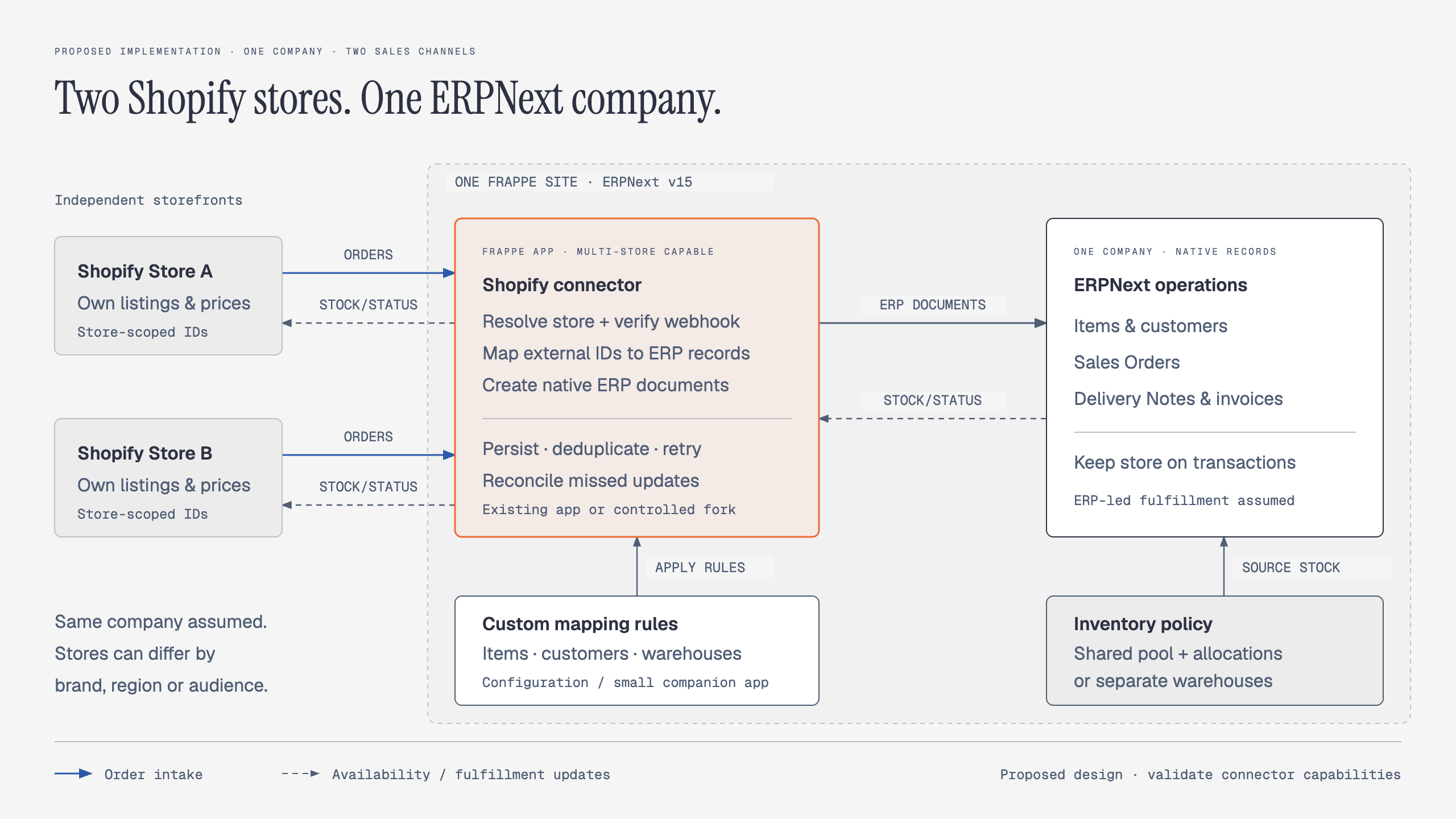
Now I want to connect two different Shopify stores to the same ERPNext instance. The goal is to manage orders, products, and customers from both Shopify stores within a single ERPNext system.
@agrutsav
Currently it is one to one as you can not configure more than one store with your ERPNext instance.
Please note this AI response so verify the facts, capabilities/possibilities.
Assuming both stores belong to the same company, I would treat them as two sales channels within one ERPNext Company.
Frappe’s standard connector uses a single Shopify Setting; its multi-store PR is still unmerged. My lowest-overhead approach would be to evaluate a multi-store Frappe connector such as NexWave in staging, keeping custom mapping rules in a small companion app. A controlled fork of ecommerce_integrations is another option if preserving the existing integration is important.
The key boundaries are:
- Store: separate credentials, listings, pricing, and transaction provenance.
- Item/customer mapping: use
(store, external ID) mappings; link to shared ERP records only where appropriate.
- Inventory: map each store’s Shopify locations to eligible ERP warehouses. Shared stock needs a reservation/allocation policy; separate stock uses separate warehouse mappings.
- Sync: import orders into ERPNext, publish availability back, and choose one fulfillment owner. Persist events, prevent duplicate processing, and reconcile missed updates.
Before choosing a connector, verify two stores → one company, including shared Items and warehouse mappings. “Multi-company support” alone does not prove this works.
Research notes — omit from forum post