RANT: Why can't you stay constant?

Guys, I am fed up. Don’t change just for the sake of it. Consistency is a key to a resilient software.

Seriously though, below are some list that you guys messed up in the past so bad.

  • How many design of Wiki have you gone through? Like can’t you really choose one and stay with it?
  • Storing and editing docs through Github was really good until you decided to mees it up all.
  • Broken links throughout the docs and official sites. You know why? cause you change the frontend and URL structure two times a year.
  • last month Angular, this month React, coming month Vue. I know frontend guys have a disease but system-admins can’t keep up with your shit.
  • how many css template engines, have you gone through in the last 5 years alone?
  • Home Dashboards, why can’t you create a solid design and stick with it?
  • Frappe DocType structure, Why did you change it? It was already really good.
  • choose a package disctributin method and stay with it. Node? Yarn? whatever choose one
  • Docker is not a magical fix for your package messness, fix the root cause instead of shoving alternatives
  • How many seperate apps you guys have? Seriously WHY? Why can’t you merge them all?
  • DON’T RE-INVENT THE FUCKING WHEEL!!!
  • Who asked you for a Teams app or LMS or Mail server, really?
  • Use the exisitng OSS tools and push updates to the master repo, instead of re-coding from scratch
  • Coding a new product is the easy part, Maintaing that codebase for years is the hard one. So don’t do it. Integrate with existing OSS tools.
  • Why don’t you start develop a new kernel while you’re at it. Let’s re-invent a device kernel with frappe, Sounds good?
  • Your efforts are being wasted on useless crap, Don’t do that
  • No one really cares about the frontend looks, and if they do they are bad customers. Don’t listen to them.
  • You know what matters in the frontend? How fast you can get your work done with less no of clicks and types.
  • Same frontend for 10 years but still works? That’s what we need for stable software. I don’t want to rewire my brain for every two years.
  • Men live with the same woman for their whole life. Have they got bored, NO? They adapt to live with her. So, Don’t change the frontend for visual sake. Please.
  • Real comapnies are highly depending on your software, so Don’t play with it and treat it seriously
  • Whatever you do, maintain backward combatiabilty with old versions for atleast 5 years

P.S: I know how hard is to make a good software and I am grateful for ERPnext so don’t take it personally.

But you know what you guys are doing, You build a product and before it becomes stable and free-of-bugs you move to a newer product. Build a single product and do it good, so it becomes the industry standard and stable enough for daily usage.

You developed a datatable for frappe in the past and It had a lot of bugs. Instead of fixing the old one, you dumped it and started a new one with newer and different bugs. So now you have two broken datatables with lots of bugs, NICE.

Who else shares the same thougt here?
12 Likes

As the title says, this post is definitely more of a rant than constructive feedback, and I don’t agree with every point. But it does touch on something important.

Frappe has grown beyond the stage where it can behave like an early startup that constantly pivots and throws new ideas at the wall. There are companies running critical operations on this stack and partners making long-term investments in it. With that come different expectations, and for me the most important one is simply stability and long-term support. Innovation is still important, but so is stewardship (especially with core apps like frappe, erpnext and to some extend hrms).

I think part of this comes down to something stated openly on their careers page: “Our team has complete freedom to choose their work goals, the projects that they want to work on, and how they want to work.” (Careers at Frappe). I actually like that about Frappe, I’m not a fan of heavy top-down management either. But with that freedom comes a need for transparent communication about strategic direction and priorities. From the outside it can sometimes feel like “what do I feel like building today?” — and the PostgreSQL support for ERPNext is a good example: genuinely useful, but it’s hard to know whether it was a strategic priority or just something someone wanted to work on.

Two things stand out for me. The first is finishing before rewriting. Rewrites feel like progress, but a half-finished replacement is usually worse than a known, hardened original, and you often end up maintaining both. The discipline that’s missing isn’t “don’t innovate,” it’s “harden and finish one thing before starting the next.” Polish what exists, close out the bugs, and only then consider replacing it. It’s not as exciting for developers. Especially younger ones who want to redo everything the modern way, but sometimes stable and proven is perfectly fine.

The second is the steady stream of new apps. Every few months there’s a new one, and while I understand the ambition to build a broad open-source ecosystem, some of these feel hard to justify. A Teams alternative, for instance, when solid open-source options already exist. Meanwhile existing apps still have gaps that matter for real usage. From the outside it’s difficult to tell which apps are strategic long-term products and which are more experimental. As the ecosystem matures, that distinction becomes increasingly important, partners need to know what they can safely build a business around. I made a similar point in the CRM discussion: Why does Frappe CRM feel underserved? - #10 by marc_centura.

Frappe is a powerhouse. But especially with the push toward agentic coding now in the mix, the stakes are higher. That direction can either bring the focus and consistency this ecosystem needs, or (if no organizational changes are made) accelerate the exact problems being raised here.

5 Likes

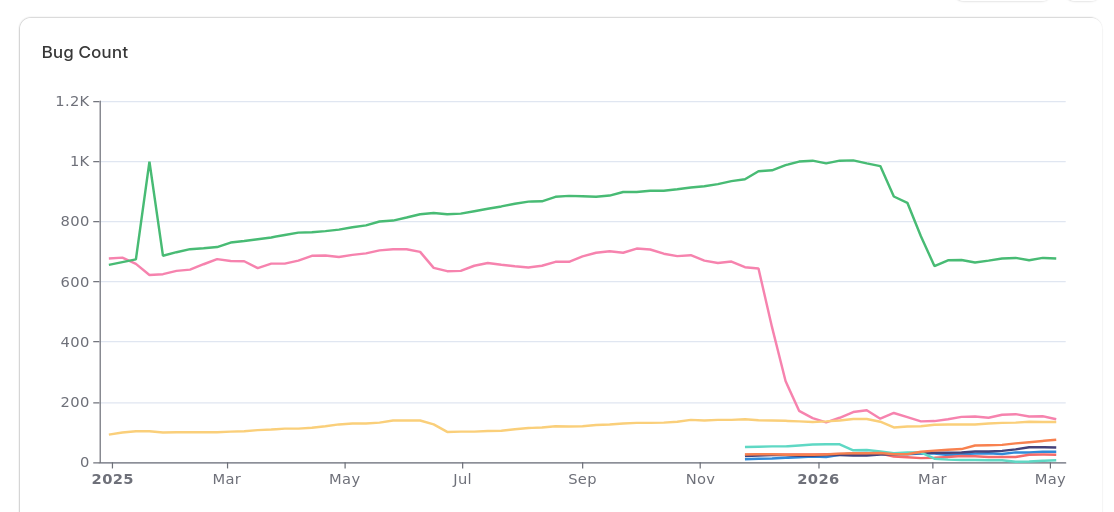
It is incorrect that we don’t care about stability. The bug count on GitHub has been trending lower now than ever.

But building good, stable software is hard and that is why in spite of “agentic workflows”, we still find it hard to find such software. The reason is that the combination of scenarios for such kind of transactional software are exponentially more than what you think.

The first thing we have realised if we were ever to make use of agentic tools is that our harness - the codebase and the test coverage have to be excellent. That is what we are working on.

Sorry we don’t meet your expectations, but it is hard enough to meet our own!

8 Likes

because

you can build a ‘bridge’ app or literally a few lines of server script from within the UI to connect as many apps as you want.

Last time I checked Frappe Studio supports custom Vue components and more recently, AI to create your custom frontends. Use it to build your UI and skip the desk all together.

1 Like

There is really need for change of UI (I have been in big boardrooms where all systems and other vendors provider same features and functionality then UI will kill the deal and decision makers focus on UI more than and of your backend code )l think we need to look at odoo ui as a good example it sells itself by default and well structured data and very visible .

l differ with you on UI , the reason you see odoo excelling now is because of its nice UI , on ERPNext menus are spread across all the pages , you on purhcases you find items doctype there and many others are missing one have to search and this means only a person who knows ERPNext can know what to search and how to search for it , this does not support new members to join the community .

Then issue of Apps , l dont think that one is a big issue since that was the original structure

1 Like

This is true, Frappe has lagged Odoo in UI / UX (more UX than UI).

The root cause for this is that our own UI development moved in the direction of Frappe UI which is only now getting merged back to the core Framework. Should have been done much earlier, but am confident we will catch up or even do better in the next 3-6 months. Now with @nikkothari22 focussing all his energy on ERPNext, we are already seeing big improvements like the improved banking experience etc.

12 Likes

@francis1 UI is the least of my concern here. Does it get the job done, effectively? Yes, Move on.

Does it look beautiful? I don’t give a single fuck. I am not planning to fuck my ERP application anytime soon. Please stop overrating this UI shit.

Well, the executives won’t think like that - Yeah, that’s true. but most executives’ collective IQ is below room temperature so discard their opinions. It is true, that a nice UI can open you a lot of doors and perform silent marketing, but what really matters in the long term is the stability and the efficent work-flow of your apllication.

And, what gets me angry is, the guy who desgined it all from scratch getting it wrong. Please.

  • Go visit your local railway station, and look at their mangement platform; looks very ugly but works without any maintenace for more than 10 years? That’s called stability. Focus on that.
  • Go visit your local food-city, and look how fast they are operating their POS with keyboard-only that’s called speed and efficiency. Focus on that.
  • The SAP looks ugly and complex but your local cooperative bank is using it w/o any issues for the last 20 years and more importanly w/o any software updates. That’s called planning. Do it properly, the first time.

Guys, I know you’ve sacrificed a lot for this project but stop talking like those motivational speakers from TED-talk, Please. Come to reality.

6 Likes

Thank you for the acknowledgement that we need improvements in UI , we are looking forward to it .

1 Like

As far as I know, Indian Railways uses Frappe Framework.

2 Likes

Hahaha The rant is too funny but totally spot on. I’d be much happier without yearly UI updates, just continuous improvements, more security, more efficient calls, new features. The Frappe team should be working on building a robust framework. The ERPNext and other project teams focus on features, reporting, etc.

But please hold off on new UI improvements. This last version was sooo unnecessary and it took over 6 months to iron out bugs that wouldn’t have been made if the UI stayed the same.

4 Likes

I think you need to divide UI (user interface) from UX (user experience). Odoo has fantastic UX because each module has a different look and feel. In frappe in contrast is sterile like a lab or hospital. All modules look exactly the same, and the only way to know is by looking at a small breadcrumb at the top of the page. The second thing Odoo does very well is if there is a workflow it shows the document where it stands in the workflow. While frappe is more of a drop down button you use to move forward or back in the workflow.

Issues with Odoo … extremely slow. I feel Frappe is a lot more snappier and efficient than Odoo in this regard. Frappe is also fantastic in customizations, development, IMHO second to none.

UI: Frappe is miles ahead. It looks minimal, elegant, lets you focus on whats important.

UX: Frappe is miles behind. It looks sterile and the modules lacks character (color) which is important for new users. Also their ability to make workflow seam like a guided form with a progress bar is amazing in helping users understand what needs to happen next.

Customizations: Frappe is far ahead. It allows a regular non-developers to make changes to their forms with relative ease.

4 Likes

See your point, but many good things came from weird experiments … :vulcan_salute:

4 Likes

l beg to differ on UI improvements , our current plain UI needs a complete overhaul , you cannot compare it to even in terms of functionality wise its not comparable to odoo , there are many other things you can do with odoo framework you cannot do in Frappe.

Then odoo UI structures data well , mostly reports , configarations , operations , master and visuals. Which is quite differetn in Frappe all these are all found on one big and unfornately some of the shortcuts or menus will not be there and one have to search so if its new users joining the community they cannot guess how to search for which doctype

Regarding the Odoo UI. I’ve actually been thinking a lot about Odoo lately. Giving it some very serious consideration and evaluation.

I have Odoo Community v18 on my laptop. And in my opinion, the UI/UX is rather awful. I tried to write a simple Sales Order, and it was very aggravating. Not intuitive. Bad defaults. Wasted screen space. No real “Desk” landing page. Many visual distractions. A lot of features/components getting in the way.

After spending an hour in there, I started -really- wishing I was back in Frappe/ERPNext.

That being said…

  • Does the Frappe UI/UX need more work? Yes.
  • Are there aggravating moments and limitations I encounter? Yes.
  • Was v16 another step backwards? Also yes, in my opinion.

But overall, I think Frappe/ERPNext wins on web interface. I’ve never had a client complain to me about the UI being too spartan. There’s nothing wrong with crisp, clean and minimal, and easy to navigate/edit.

9 Likes

you acknoledging UI is not good and you are saying lets leave it like that and focus on other things ???

As for me l present ERPNext in competative environments , have lost quite big deals because of UI , and most of these clients cost is thier least worries , you will be at same positioning with other competitors , ERPNext will be eliminated in first round because of UI . You cannot debate on features or customisations all systems on the table will be having capabilities . ERPNext can win when there is no competitor , when you are the only system intergrator onboard otherwise you will be doomed . So we definately need investment in XI .Current UI is only for us who knows it otherwise for new entry its a barrier

i agree. I’ve been selling both odoo and erpnext since last 11 years. Odoo, especially the Enterprise version, looks fancy and a pre-sales consultant can easily use the ui to fool people who can’t look beyond it. It is an easy sale; ui, extraterrestrial marketing everywhere, and just the hype. But it’s nothing more than that. If you’re a real deal, an enterprise looking for a real ERP system like sap b1, dynamics gp, etc. you can’t use odoo without basic customization like ship to and bill to addresses don’t even show after selection. I have written a detailed blog about those comparision.

Sure, at first erpnext ui looks rather boring but think about the real use case here, the users of such apps are forced to use a system, they have jobs to do outside the system, they don’t care if it looks fancy, as long as it has features and is easy for them to get their work done and go home to their life. Erp are to be looked like an enterprise app and not some colorful playful app that people use to satisfy their desires.

5 Likes

l agree with you odoo sales easily than ERPNext just because of looks alone . l struggle a lot to convience clients to use ERPNext instead of odoo because it will be lacking some basic features but currently odoo 19 the latest version have put most of the features they used to hide . Most clients actually come looking for odoo some am able to convience to ERNext but some not so l will put on odoo . Is some cases client will tell you to present both systems and the moment you do that then you know ERPNext will not be favoured nomatter how talk about its features

As a real consultant our job is to suggest what is write and then if customer still goes ahead with Odoo then you have nothing to loose. I have at least 2 instances in which the client came to us and said let us go ahead with your original suggestion of ERPnext. We can consult on either product. But it’s our job to understand the requirements and then suggest what works better for the client. In this case, you don’t loose the client plus increase your offerings

1 Like

As a user and administrator and implementor for over 10 years, that RANT called to most of my feelings. I totally agree that great products depend on reliability and sustainability under the hood. I do not think anybody complained about the interface so far. Rather, management of generalized business processes and to achieve international compliance over a solid universal process kernel is more important to reach to serious customers like the big software companies attract. Even though I have been able to convert an SAP customer, I never saw a complaint regarding the interface rather than the universal business process alignment. Many projects went to local implementation and lost universal focus, thus has been dropped because of loss of interest. With the advances in AI, people with mode solid business process standardization capability will grow while other approaches will produce products that are deviating too far from the original code and damaging maintainability. @rmehta may it be that there are not enough users so far that the bugs reported are low? Not all processes have been tested like year end closing and such. ERPNEXT is phenomenal as it gets but I think the directions taken are diverting the product from sound competition.

3 Likes

While the Frappe UI is undeniably beautiful and minimalist, there is a growing disconnect between its aesthetic appeal and its practical user experience (UX). ERPNext is a massive, feature-rich platform, but its steep learning curve and outdated documentation frequently scare off new users. Too many implementations stall because end-users simply find the system daunting.

I propose that Frappe put a temporary freeze on purely aesthetic UI improvements to focus strictly on functional UX. Here is why:

  • Disruptive Micro-Changes: Small, unannounced design tweaks cause massive friction. For example, moving the explicit text “Print” button to a tiny, minimalist icon in a different section in V16 triggered numerous support calls from users who thought the feature was removed.

  • The “Form Over Function” Trap: The current design language feels “Apple-ish” but isn’t.—built by developers and designers, for developers and designers. It often overlooks the actual day-to-day end user (Apple does that last part very well, they don’t minimize for the sake of minimizing. They keep switches large, text easy to read, good contract, good mix of colors to convey urgency).

  • A Vastly Diverse User Base: Our user base spans generations. We have veterans who started on MS-DOS and Windows 95, alongside digital natives who knew how to unlock an iPhone before they could walk.

As a community, we need to design for the actual people using the software to run their businesses every day, not just for the sake of minimalism.

Instead of being negative because i’m extremely appreciative that ERPNext is open source. Here is my take:

Improve Frappe’s Accessibility. Do A/B Testing to decide where buttons should be placed and have users vote on which one they like best and then implement that. Have survey’s popup every now and hen and ask users their preferences. Have all this info feed back into a centralized server where data is collected and analyzed. Become like Google. I read a story once they were deciding on which shade of blue to make a button and they had answers from several million users seeing how they used the button and decided based on that which shade of blue to use.

5 Likes